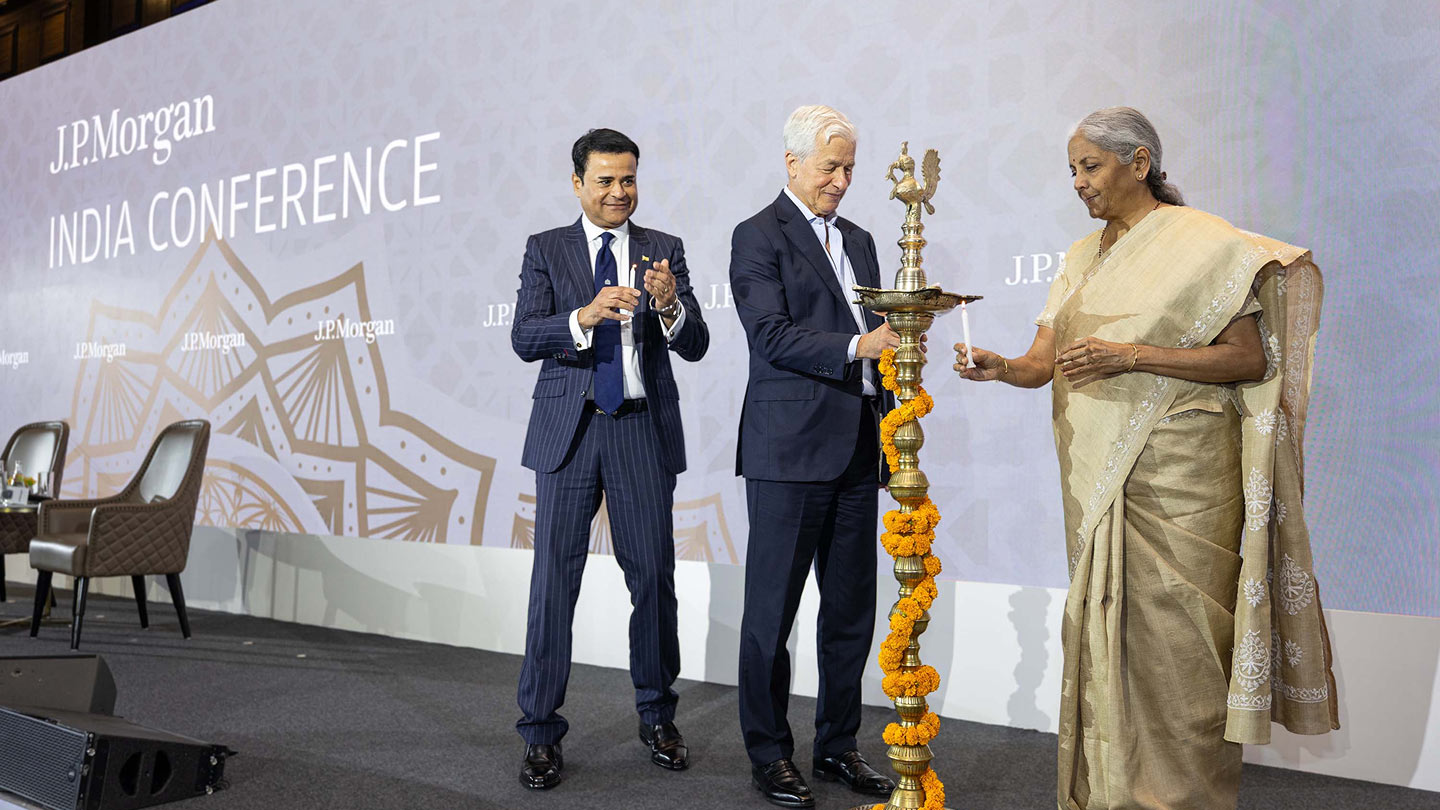
The 11th J.P. Morgan India Conference, held in Mumbai on September 21-22, 2026, convened more than 1,100 delegates from over 100 companies and institutional investors globally. Bringing together investors, C-suite executives, policymakers and thought leaders, the conference provided a forum for conversations on India's economic growth, emerging sectors and the opportunities shaping its long-term investment story.

Key takeaways from the
J.P. Morgan India Conference 2026
Inside the industries powering the world's fastest-growing economy
India's growth has consistently defied a turbulent global backdrop, expanding 7.8% over the past year despite tariff, oil and geopolitical shocks to become the world's fastest-growing major economy. At J.P. Morgan's 11th annual India Conference in Mumbai, the conversation returned repeatedly to that resilience — and to the drivers of India's next phase of growth, from private investment and manufacturing to consumption and infrastructure.
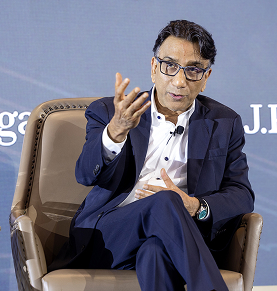
India's economy has continued to outpace its peers, expanding 7.8% over the past year even as higher energy prices, geopolitical shocks and tariffs weighed on the global outlook.
"India is expected to remain one of the world's fastest growing major economies, with growth forecast at around 7% this year," said Rahul Badhwar, Senior Country Officer, India at J.P. Morgan. "In a world where sustained growth is increasingly scarce, India continues to stand out."
That resilience was hard-won: over the past year, India absorbed an effective U.S. tariff of around 34%, a renewed run-up in oil prices and elevated global interest rates, factors which could have toppled a less well supported economy. However, a run of domestic policy measures helped to cushion the blow. Direct-tax cuts, a landmark Goods and Services Tax (GST) rationalization, roughly 150 basis points of rate reductions and a real effective exchange rate that has depreciated close to 15%, boosting exports.
For Jahangir Aziz, Co-head of Economics Research at J.P. Morgan, much of the resilience rested on a remarkably strong consumer, even as the real-economy impact of the AI investment boom has proved more modest than headlines suggest. Luis Oganes, Head of Global Macro Research, pointed to a deeper shift across emerging markets: India and its peers have become far less reliant on foreign portfolio flows than in previous cycles. This structural change that has helped the asset class weather tariff, oil and rate shocks that might once have destabilized it.
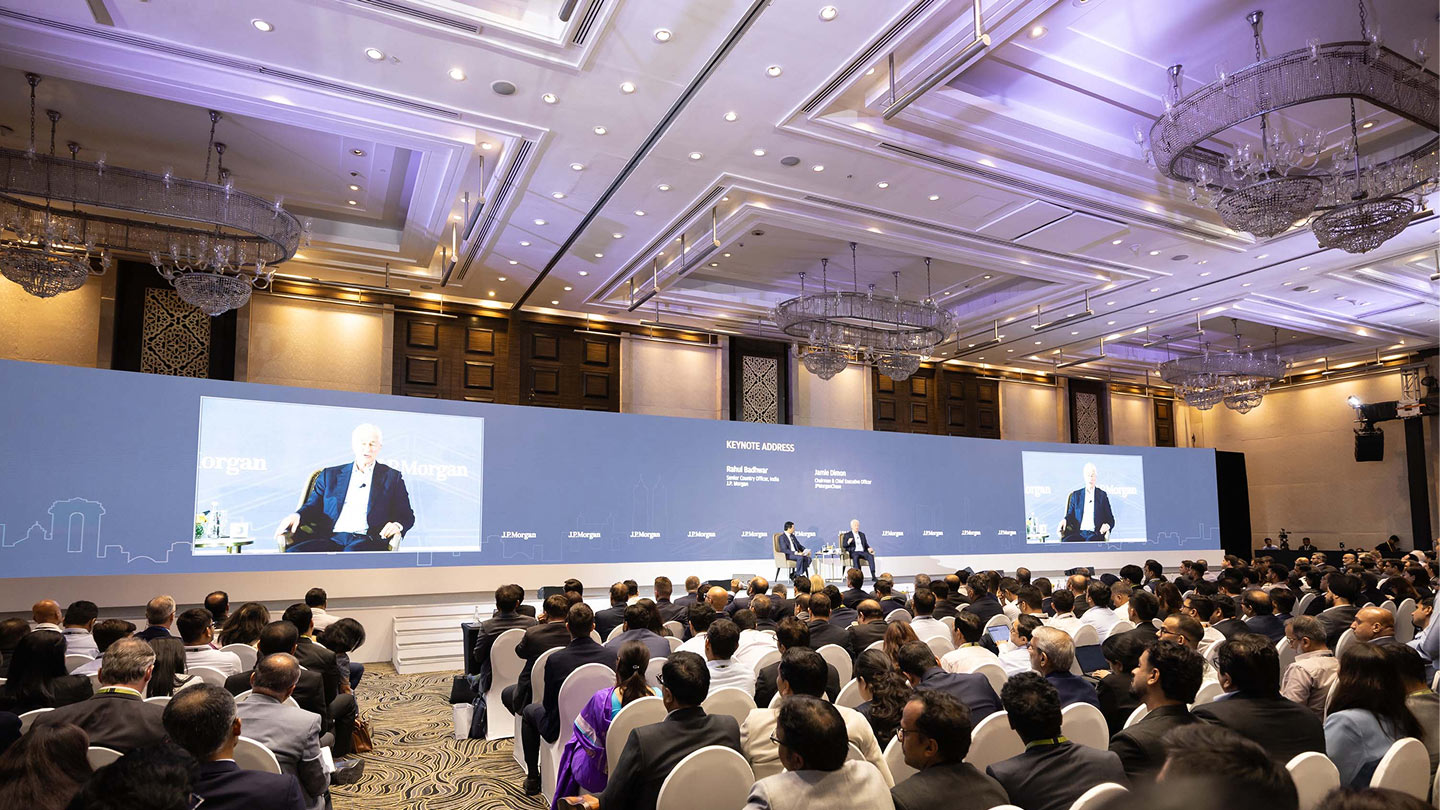
Jamie Dimon, Chairman and CEO of JPMorganChase, was equally optimistic about the runway for the country’s growth. "You're the fastest growing economy on the planet today," he told over 1,100 delegates and institutional investors from around the world in attendance, adding that India "has even further to go," with hugely capable companies and a deep pool of engineering talent.
Dimon was candid about the constraints, too, flagging the country's excessive bureaucracy and a tax regime that too often deters foreign direct investment — but said J.P. Morgan would continue to invest in India for the long term.
The path to India's next phase of growth was a key theme, with panelists consistently pointing to the need for a shift in private investment. Private corporate capital expenditure (capex) has held around 10% to 11% of GDP over the past decade, well below the nearly 17% reached before the global financial crisis, while manufacturing capacity utilization has stalled at roughly 75%.
Public and real-estate investment have both picked up, but the missing engine has been the private corporate sector — and signs that it is finally turning over are starting to show. Executives at Larsen & Toubro — T. Madhav Das, Director and Senior Executive Vice President heading the energy and hydrocarbon division, and CFO P. Ramakrishnan — pointed to a broad-based rebound in private capital expenditure across coal-based power, renewables, semiconductors, electric-vehicle manufacturing and steel. This cycle, they argued, looks more disciplined than the last, with healthier corporate balance sheets and companies weighing risk and reward carefully before committing.
Against that backdrop, the investment discussion brought together two perspectives: one from public markets and credit, the other from private equity.
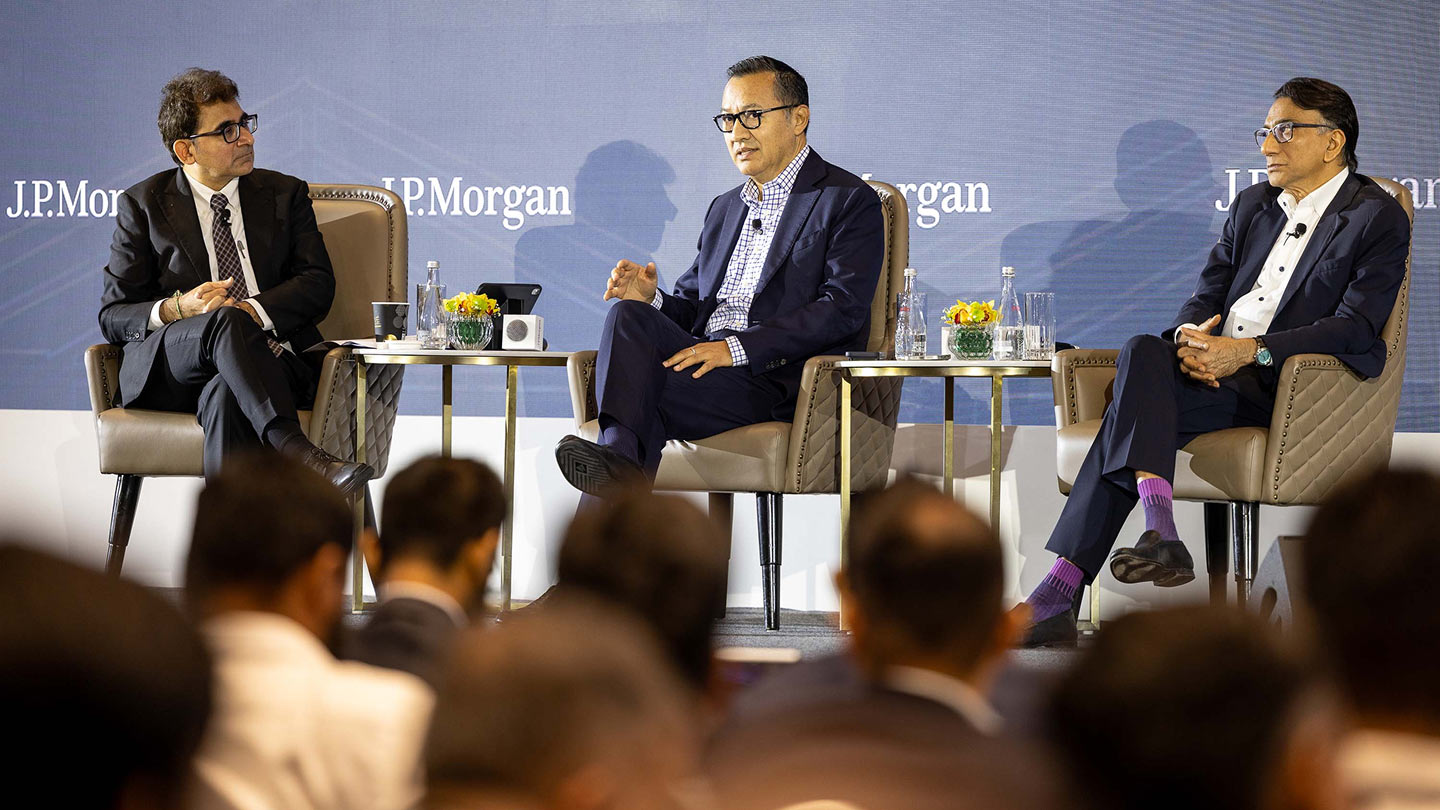
“When you look at the amount of global investment into India, there's a misalignment. It's at one of the lowest points of global money coming into India. However, the fundamentals of growth, demographic trends, innovation and regulatory stability should attract more global capital into these markets," said Anu Aiyengar, Global Chair of Investment Banking at J.P. Morgan in a panel discussion with Amit Dixit, Head of Asia at Blackstone.
Dixit said Blackstone concentrated on five areas: technology, financial services, consumer, healthcare and value-added industrials. Those sectors, he said, play to two of India's core strengths — domestic demand, through financial services, healthcare and consumer; and global competitiveness, through the export-oriented technology and value-added industrial sectors.
On artificial intelligence, Dixit said Blackstone is now investing across every layer of the AI stack in the country. At the infrastructure level, it owns data-center developer AirTrunk and has backed compute company Neysa — a "neocloud" modeled on the firm's U.S. build-out which has grown rapidly.
The demand, he argued, is already there: India is among the world's largest consumers of AI. The country ranks second globally in use of both ChatGPT and Anthropic and first in Perplexity, driven by a population of 850 million people under the age of 35 with access to cheap data. Yet those queries route to data centers overseas rather than in India — a gap expected to close as data-privacy rules push compute onshore.
While India may be late to AI, what is emerging from the investment in the country’s AI-related industries, spanning infrastructure through applications — will surprise investors who have stayed away, added Dixit.
Howard Marks, Co-chairman of distressed-securities investor, Oaktree Capital Management, focused on cycles, valuations and risk discipline, arguing that risk control must always come first. Investors, he said, should participate through the cycle without leaning too heavily on macro forecasts or market timing.

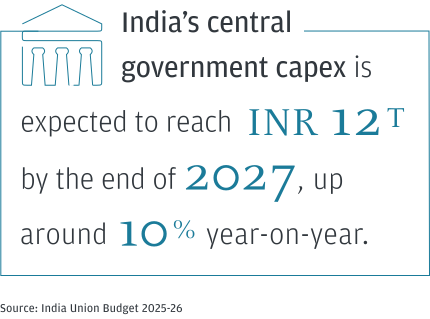
If the investor debate was about where capital would come from, the corporate one was about what it is building — and how India is pushing up the value chain into advanced and electronics manufacturing services (EMS).
That build-out rests on a capex cycle that has expanded severalfold over the decade, with central-government capex rising from around 4 trillion Indian rupees (INR) ($45 billion) in 2020 toward 12 trillion INR by the end of 2027.
AI ran through the corporate story as much as the investment one, with panelists highlighting the scale of the opportunity over any potential threat.
Sunil Vachani, Executive Chairman of Dixon Technologies, one of India's largest EMS companies, said the domestic industry is worth around $150 billion today — just 3% of a roughly $5 trillion global market, leaving enormous room to expand.
For Managing Director and CEO of Siemens Energy India, Guilherme Mendonca, the case for building in the country rested on competitiveness and reach. The company allocates orders across its global network of factories to whichever plant is best positioned, and its Indian sites are increasingly winning that work and exporting worldwide.
Higher logistics costs have to be offset by India's competitiveness in the supply chain and components, but that equation is improving, helped by the government’s success in negotiating attractive free-trade agreements with partners such as the U.K.
Mendonca also stressed the long horizon behind such decisions: factory investments are fixed assets depreciated over 30 years, and India's appeal, he said, lies in demand he expects to keep growing well into the future.
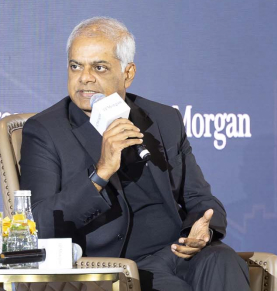
India's consumption story was another recurring theme, and packaged foods offered one of the clearest signs of momentum. Manish Tiwary, Chairman and Managing Director of Nestlé India, described growth accelerating from a long-run trajectory of around 10% to more than 18–20% in recent quarters. This shift was largely attributed to Nestlé's good on-ground execution besides the GST overhaul, which cut rates across a wide range of consumer goods.
Packaged foods are at an inflection point, with penetration still far below that of household staples — with noodles at roughly 20%, against laundry products near 100%. The task is not to choose between reaching new households and trading existing ones up, but to do both at once, noted Tiwary.
Consumer behavior is shifting elsewhere, too. Quick commerce is driving impulse purchases and premiumization rather than cannibalizing general trade. India was Nestlé's fastest-growing market in the first half of the year and now ranks among its top five, with rural growth outpacing urban.
“Quick commerce has become an important growth opportunity for established consumer companies. Investors have largely viewed it as a source of competition, but we are seeing a shift, with incumbent players now using it to expand their reach and create new growth opportunities,” said Latika Chopra, Co-head Asia Pacific Research and Head of India Consumer Research, in a media interview on the sidelines of the conference.
If packaged foods spoke to the mass market, jewelry has captured the premium-end. Ajoy Chawla, Managing Director of Titan, the lifestyle group behind Tanishq, described a market defined by premiumization across watches and jewelry. Customers are steadily trading up as disposable incomes rise — buyers who once spent below 2,000 INR on a watch are now comfortable at 5,000–6,000 INR.
The picture remains uneven, though. A "K-shaped" recovery has been apparent since the pandemic, with the affluent pulling ahead while lower-income and more traditional buyers feel the strain of inflation and urban living costs. Record gold prices — up three to fourfold over recent years — have sharpened the divide. Many plain-gold pieces are now out of reach, prompting buyers in the sub 100,000 INR segment to trade down, delay purchases or turn to silver.


Is India’s equity market the best AI hedge?
As global investors trim or diversify away from crowded AI trades, India’s equity market is emerging as the world's largest, liquid non-AI hedge. What is the outlook for stocks as earnings rebound?
India's growth outlook
A conversation with Sajjid Chinoy, head of Asia Economic Research at J.P. Morgan, on the macro forces shaping the decade ahead.
There’s been a big debate about the recently released GDP print within the country. What are your thoughts?
The recent debate around the GDP print is a storm in a teacup. There should be no doubt about the sanctity of the new GDP print. The methodology has improved significantly. Furthermore, the number itself should not be a surprise. The high-frequency data for the last three months has been very strong: autos, credit, earnings, exports have all been buoyant. We had therefore forecast GDP growth at 8% for the quarter, which was between the gross value added (GVA) print of 8.2% and the GDP print of 7.8%. Therefore, it came as no surprise to us.
Instead of debating the sanctity of the GDP print, the debate needs to be about its sustainability. What we are seeing is a sharp cyclical upswing, underpinned by (i) the fiscal, monetary, regulatory easing in 2025; (ii) the impact of the sharp depreciation of the real exchange rate that can be expected to be expansionary (importantly: net exports was a huge driver of the recent GDP print); and (iii) very adept handling by policymakers during the Middle East crisis wherein energy imports were quickly diversified to prevent widespread shortages.
But for growth to continue at this pace, the cyclical will have to morph into the structural. This will entail crowding in the private capex cycle which, in turn, will require sustained demand visibility. That will require continued focus on job creation to boost consumption and improving export competitiveness.
The Foreign Currency Non-Resident (FCNR) scheme has been a huge success. But, as you have written, it has left a liquidity overhang. What are the RBI’s options?
The deluge of FCNR inflows gives a lot of near-term ammunition to the Reserve Bank of India (RBI), but the collateral impact is a significant easing of monetary conditions that the RBI will need to respond to. At some level, none of this should be a surprise. Back in July we had written a piece “The Good, The Big and the Tricky” anticipating these dynamics. Markets were skeptical of large inflows. But, as we had shown in that note, the dollar return to Non Resident Indians, after the subsidized swap, was in the 13% to 15% range, a substantial pick-up over risk free dollar returns. Therefore we were anticipating large flows, though the eventual number exceeded even our expectations.
This provides important firepower to the central bank, at a time when the global environment is becoming more hostile. Crude prices have flared up and developed market bond yields are on a tear. The collateral benefit has been dollar hedging seems to have moderated.
The tricky element is the liquidity hangover. The deluge of FCNR flows has created an equivalent Rupee quantum in the banking system. At last count, the core liquidity surplus in the banking system was above ₹13 trillion and the headline surplus was ₹10 trillion. Weighted average overnight rates were therefore substantially below the 5.25% policy rate, resulting in a de facto easing of monetary policy.
This is at odds with the signal from the August Monetary Policy Committee (MPC) minutes that the RBI may need to hike rates in the coming months. The central bank will therefore have to aggressively sterilize these inflows.
Of course, these FCNR inflows need to eventually be repaid. So they buy India time. What we do with that time to generate balance of payment surpluses will be crucial.
India's 2047 developed-economy ambition requires sustained high growth over two decades. What are the two or three reforms or investments most critical to staying on that trajectory?
For India’s per-capita income to reach $15,000 by 2047, per-capita dollar growth will have to accelerate from about 6% over the last decade to almost 8% over the next two decades. This will not be easy in a world of increased economic balkanization, rampant Chinese capacity and AI that could be as labor-displacing as labor-augmenting. To grow at higher rates against this global backdrop, India needs to become structurally more competitive and use its greatest assets – its people – more effectively. This will involve sustained factor market reform (land, labor, power), deregulation, more trade liberalization and, most of all, deep investments in human capital (education, health, skilling) so that labor can compete more effectively with capital.
Conference photos


Making an impact
JPMorganChase has been making an impact in India since 1945.
$80B+
in credit and capital provided to clients across various industries since 2019
1.3M+
volunteer hours completed since 2018
$90M
in philanthropic contributions since 2015
331K+
instances of improved financial health due to philanthropic programs
100,000+
people assisted in accessing promising career pathways since 2019
BANKING
Market signals and what they mean for companies in Asia Pacific
From diverging central bank policy to the AI investment boom and higher-for-longer energy prices, J.P. Morgan's Global Corporate Banking leaders unpack the macro forces reshaping the region — and what they mean for companies.

GLOBAL CORPORATE BANKING
Perspectives from Asia Pacific
Explore Global Corporate Banking's Asia Pacific market outlook.

PAYMENTS
J.P. Morgan Payments in Asia-Pacific
At J.P. Morgan, we’re thinking differently about the power of payments. Let us help you rethink what payments can do for you.
This conference is by invitation only and is not transferable. The conference is not open to the media.